Technical data to enable construction and fire industry professionals to assess and specify Automist for uses such as solving fire building regulation issues in open plan kitchens and loft conversions

Automist is covered by an LABC Registered Detail (RD171) for use in open plan layouts in loft converted houses. The Registered Details scheme allows building control officers to approve a project without a long and detailed investigation. This page provides additional technical information for those that seek an understand of the principles and testing that underlie Automist.

A fire suppression device like Automist aims to control and suppress fires,  significantly reducing the risk of injury, life loss and property damage by maintaining tenable conditions for as long as possible while occupants evacuate. This is achieved in several ways:

  • Reduction of room temperature in the region of the fire. Water mist devices achieve this by consuming much of the fire’s energy in converting water to steam.

  • Reduction of smoke and toxic gases. Water mist devices achieve this by the production of copious amounts of inert steam in the immediate vicinity of the fire, locally excluding oxygen, reducing temperatures and thus slowing the oxidation reactions of the fire.

  • Flashover prevention. By constraining room temperatures to around 100°C or less, flashover (the rapid ignition of combustible items in the room) is prevented.

  • Providing cooling to structural elements of the home that are in the spray path, allowing them to resist the fire for longer.

Automist may often provide a more reliable safety measure than the traditional measure of fire doors, which Approved Document B now allows not to be equipped with closers.

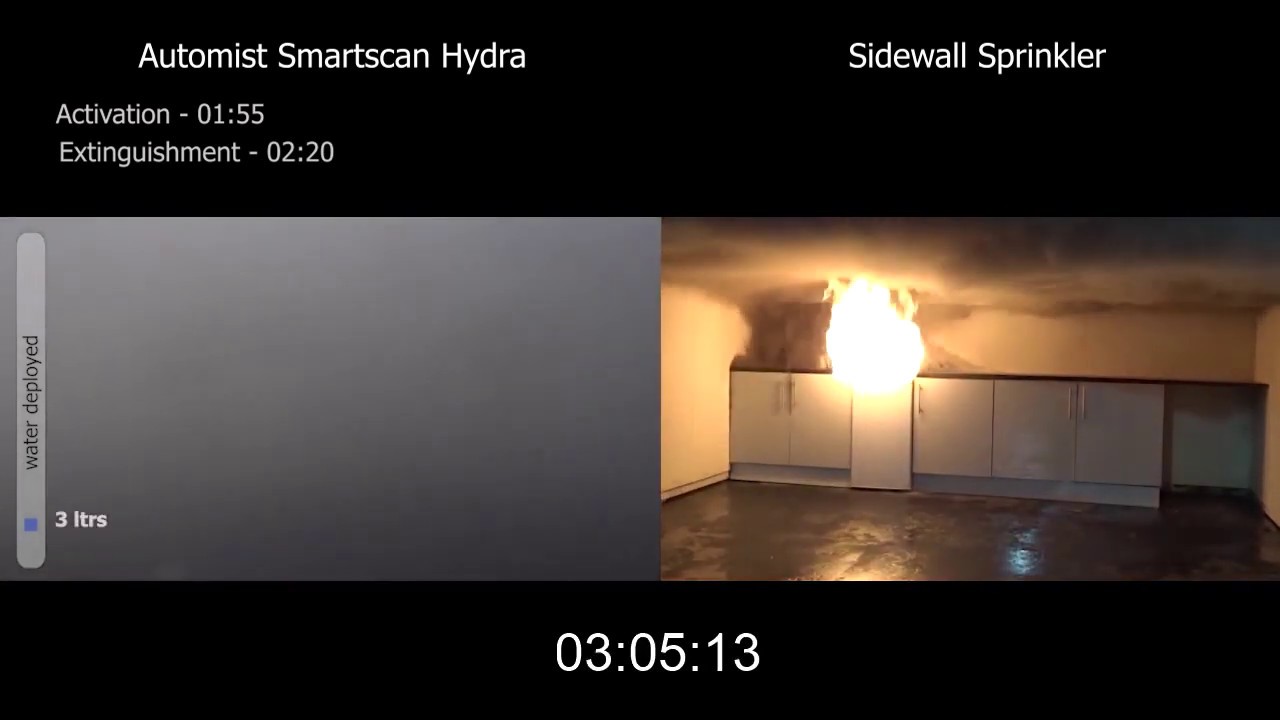
In one of the most comprehensive test suites ever run on a mist product at the Building Research Establishment (BRE), Plumis verified the effectiveness of Automist with live burns in a series of different scenarios. The test was based on BS EN 1869:1997, DD 8458 1:2010, and the criteria of Scandinavian SRSA/DSB "Easily installed automatic extinguishing systems". Critically, Fractional Effective Dosage (FED) measurements and "free burn" control tests were included to allow a complete and objective assessment. These tests were run in BRE Global's Watford (UK) Burn Hall and mimicked both
furniture and kitchen fires.

In every test where a "free burn" unsuppressed reference was available, the system produced an improvement in both temperature and asphyxiant gas conditions, whilst reducing damage. Automist was found to render lethal environments survivable. In a major furniture fire, even those immobilised in the room could have survived for the entire test period of 30 minutes.

pdf Automist Declaration - Declaration of testing and conformity.pdf (149 KB)
 

Automist fire test


CPD Seminars - "A guide to sprinkler alternatives for domestic fire protection"

We deliver a high quality seminar in which delegates will learn about the benefits of active fire protection and the different types of sprinkler alternatives for domestic fire protection. Delegates will also be issued with a CPD training certificate, where required.

To arrange a seminar please contact us:
fireprotection@plumis.co.uk or +44 (0)20 7871 3899


Here are some examples of how Automist can improve fire safety:

  • Ground floor flash-over avoidance after a loft conversion or open plan kitchen refurbishment
    Automist can open up opportunities and design flexibility, helping our clients reduce their costs when meeting building regulations. Technical data is provided in our "Technical Information Pack" to enable building control to approve Automist under the building regulations and fire industry professionals to adequately specify Automist. The new part B allows Building Control Officers to consider alternative methods of overcoming fire precautions in dwellings where a loft conversion takes the property to 3 or more stories. One option is to install Automist under the ground floor stairwell to protect the escape route where compartmentation, such as an enclosed stairwell or fire rated doors, should be in place but is either undesirable or not
    possible to achieve.

    Open plan layout

  • Elective safety improvement for the vulnerable or high risk tenant
    Automist can be used to aid means of escape and maintain survival conditions by minimising toxic gases and heat, an ideal solution for sheltered housing and student accommodation. Automist is a hassle-free add-on which can be integrated easily during a refurbishment, ideal for promoting independent & assisted living. Door closers and/or retainers can be used to maximise Automist’s ability to limit the spread of fire throughout the building and increase the effectiveness of the water mist volume protection.

  • Compliance with the Regulatory Reform (Fire Safety) Order and the Housing Act
    Fire Safety risk assessments are an important part of the Regulatory Reform (Fire Safety) Order and ensures that landlords consider evacuation plans for disabled people living within their buildings. Automist can protect difficult to escape premises and help people with responsibility comply with both Equality Act 2010 (which is the successor to the DDA) and the RRFSO.

Automist WRAS approved


Technical Data

Purpose

  • Flash over prevention
  • Life and property protection
  • Elective safety add-on

Protected Volume

  • 32 sq. m area protection (2.5m ceiling height) with fire hazards up to 5m away

Water flow

  • 5.3 litres per minute

Run time

  • 30 mins default
  • Configurable with a fire panel

Trigger

  • Conventional 57°C heat detector as per ADB and EN54/ BS-589 part 6

Installation requirements

  • Reliable water supply (6 lpm flow and 1 to 10 bar pressure) with a standard BSP ¾"
    connection
  • 230V 50Hz electrical supply on an independent circuit with RCD protection

Automist fire protection technology