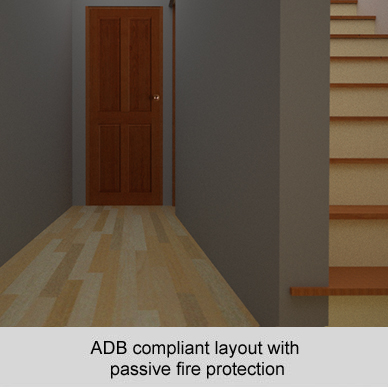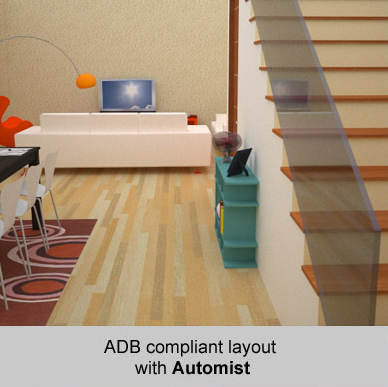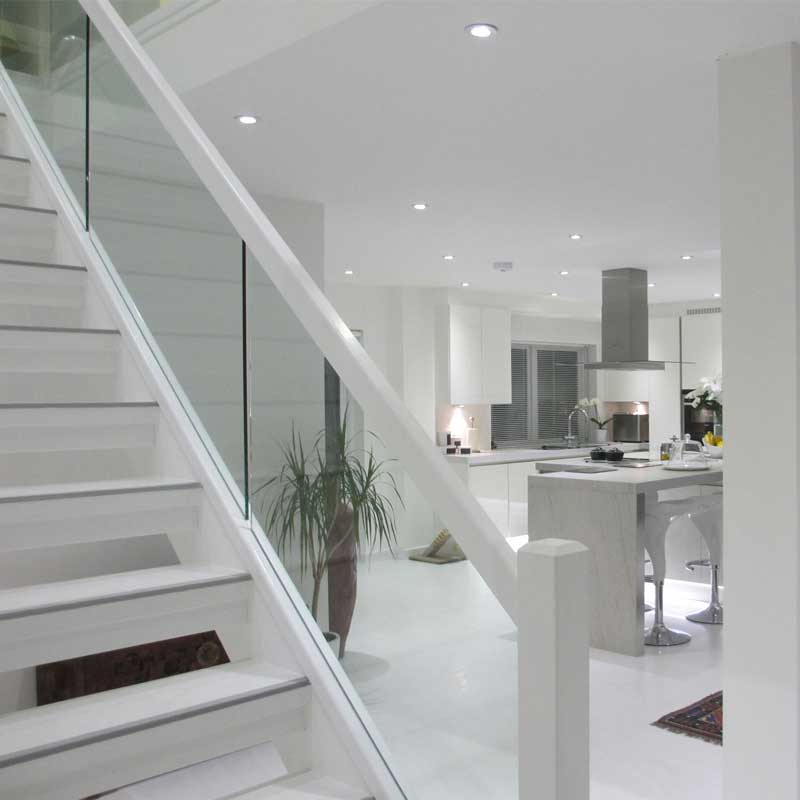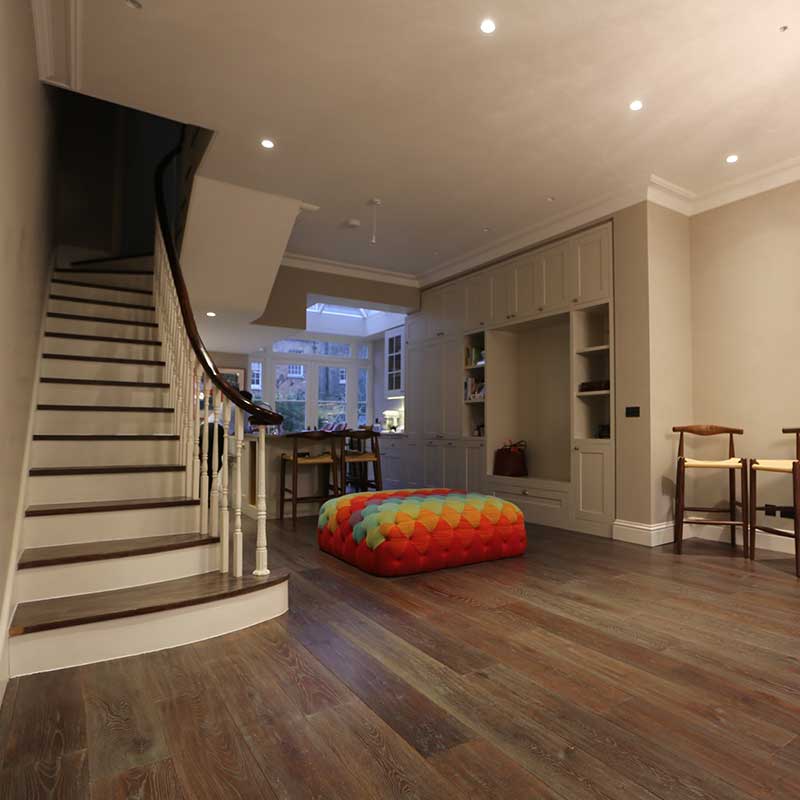
Automist can be used as a compensatory measure to meet Building Regulations after a refurbishment, such as loft conversion or open plan layout - an alternative to sprinklers and compartmentation. |
|
|
Homeowners often carry out refurbishment projects in order to create living spaces which look and feel better. Unfortunately, modern layouts are often at odds with the fire safety requirements of Building Regulations: the regulations are very prescriptive in nature and mandate either unattractive compartmentation or costly and disruptive sprinkler systems. Paragraph 0.18 of Approved Document B (ADB), Volume 1 2006 does suggest an alternative: the use of innovative fire suppression systems, such as Automist: |
"0.18. There are many alternative or innovative fire suppression systems available. Where these are used it is necessary to ensure that such systems have been designed and tested for use in domestic buildings and are fit for their intended purpose."
![]() |
Automist is covered by an LABC Registered Detail (RD171) for use in open plan layouts in loft converted houses. The Registered Details scheme should allow building control officers to approve a project without a long and detailed investigation in the knowledge that the product has been rigorously checked by LABC members. |

|
Automist gives two critical benefits, whilst reducing cost and disruption:
|
“In an open plan loft conversion, a retrofittable suppression device offers not only comparable costs to dummy walls: it solves the regulatory problem permanently and also provides permanent fire safety to occupants.” | ![]() |
Application examples:
Providing separation from risk areas
The guidance in Approved Document B recommends for studio flats that the kitchen should be ‘remote’ from the entrance door and escape route. Although it is preferable if the cooking facilities are away from the flat entrance the lack of clearly defined guidance on the meaning of ‘remote’ can lead to inconsistency. Looking at the UK national fire statistics and also reference such as BS 5839 Part 6 it is clear that kitchens are the location of over half of all dwelling fires, with cooking being the cause of ignition. In contrast approximately 15% of all fire deaths result from fires that originate in kitchens, as kitchen fires have less opportunity to spread to soft furnishings and normally occur whilst the occupants are awake and able to respond quickly.
Where differences in interpretation occur Automist can be used to help address concerns over this issue by reducing the risks associated with the cooking facilities. In this application Automist covers all occupant types and the suppression will control the fire at an early stage, minimising heat and smoke generation and providing cooling to improve the potential for escape.
Providing a protected route out from the loft rooms to a final exit at the ground floor after a loft conversion or when creating an open plan arrangement
Approved Document B, Volume 1 proposes sprinklers as a means of protecting the open plan area at ground level. Given Automist’s effective suppression performance and the satisfactory installation standards discussed in our Technical Pack it is proposed that Automist can be used as an alternative to sprinkler protection to the open-plan area.
In 2010 the NHBC Foundation released a research paper prepared by the BRE on open plan apartment layouts considering the application of residential sprinklers and LD1 standard fire alarm and detection systems as reasonable measures for enabling open plan apartment layouts (providing the apartments were with defined limits). These proposals have more recently been adopted in the draft British Standard BS9991 (the proposed replacement for BS5588 Part 1), amongst a wider recognition of the potential application of water mist systems in residential design.
Where open plan layouts are proposed, especially conversion projects where retro fitting entire residential sprinkler systems would be prohibitive, Automist provides a viable and effective alternative.
Providing protection when fire doors are either removed or downgraded
In the example of a fire engineered solution, where the plans are compliant with Approved Document B principles, the suppression capabilities of Automist can be used in conjunction with an analysis of the proposed doors material properties and comparative fire and temperature performance, where the client wished to either use a door which was not fire resistance certified or was inherently non-fire rated.
As shown in the BRE fire testing (covered in detail in Appendix A) Automist was capable of maintaining compartment temperatures to around 100°C within the fire compartment. Providing the chosen door performance is capable of maintaining its integrity at temperatures of 100-150°C and the accommodation room falls within the design parameters for Automist coverage then this proposal can be justified as achieving an equivalent level of performance.
Providing compensatory protection when fire service access is extended
Following the recent amendments to Approved Document B fire service vehicle access distances were reduced to residential buildings. Currently Approved Document B proposes that fire service vehicle access should be achieved to within 45m of the furthest point in the dwelling when measured from the fire appliance parking position. When this guidance cannot be achieved there is the potential for debate over the most appropriate and practical solutions. Approved Document B would suggest that dry rising water mains be provided where basic vehicle access is achieved however this is often disputed by fire services on grounds of travel distance, availability of water supplies and additional time prior to commencing fire fighting. It is not uncommon on compact developments for ideal access to be impossible to achieve and therefore Automist offers reasonable and cost effective alternative solutions.
When the fire service arrive at the scene the fire could have been growing for at least 20 to 30minutes (based on the time required for detection, the call to the fire service and then the fire service response) which could result in a very large fire where fire suppression is not present therefore including efficient fire service access arrangements becomes vital. In contrast with Automist provided to the accommodation rooms the fire size and the compartment temperatures would be massively reduced and also controlled (as demonstrated in Appendix A of our Technical Pack). The suppression effects would largely compensate for less than ideal fire access by minimising the extent of fire fighting required, creating relatively stable conditions and increasing the time available for fire fighters to setup prior to commencing operations. As secondary benefits the suppression will also help to improve conditions for escape within the dwelling prior to fire service arrival and also assist with limiting fire damage.
An increasing number of organisations and house builders are installing Automist in their developments.
Click the link to view some case studies of Automist installations.